

Less Common Greens – Celtuce, Jewels of Opar, Chrysanthemum Greens, Eat-All Greens
In my monthly series on unusual crops, I wrote about Peanuts in May
In June I wrote about Bug-Resistant Summer Squash Substitutes
In July I wrote about Squash Blossoms and Other Edible Flowers
In August I wrote about Kohlrabi
This month, I’m writing about unusual greens for late fall and winter meals.

Celtuce, Stem lettuce
Celtuce is the same crop family as regular lettuce. The difference is that it is bred to grow thick, succulent stalks, and that is the part eaten, raw or lightly steamed or stir-fried. It can also be pickled, or used as a gluten-free pasta substitute. Some people say the flavor of the stem is a crisp, nutty cross between romaine, celery and cucumber.

The leaves are eaten by people who like slightly bitter salad vegetables such as radicchio. Young leaves are edible about 5 weeks after planting and the stems are ready when about 12” (30 cm) tall, or shorter if you prefer. Trim and peel the stems, then chop however you like, rounds or diagonally-cut chunks. Celtuce goes well added late into miso or egg drop soup, or with tofu.
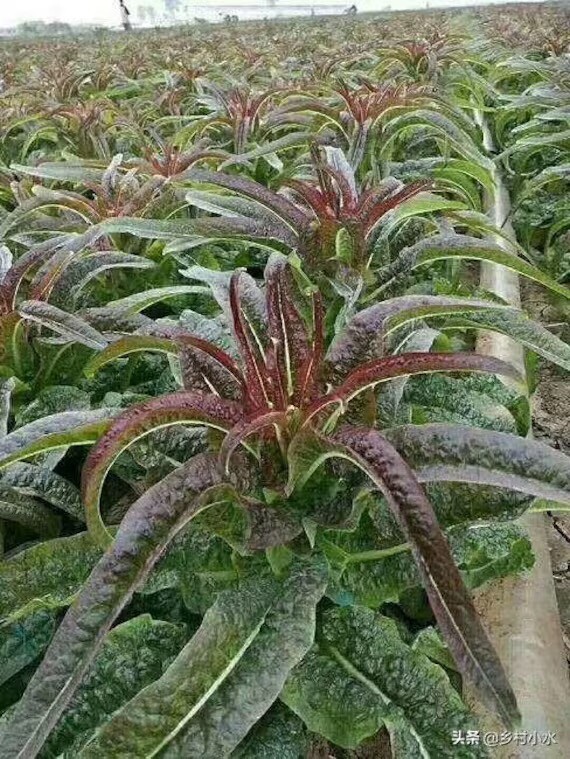
Celtuce Varieties
As an Asian vegetable, Celtuce is also known as Aa choy. True Leaf Market (Kitazawa Seeds) has a Purple Sword variety. Green celtuce varieties are more widely available, such as Spring Tower from Johnny’s. I was entertained to discover that the fast-maturing spring lettuce Cracoviensis that I grew when I first moved to Virginia has since been classified as a type of celtuce. The killing temperature of outdoor unprotected celtuce is 20°F (-7°C). It bolts readily as spring starts to warm, but the leaves are not bitter and the stem is the prize!

Credit Southern Exposure Seed Exchange
Sowing and transplanting celtuce
Sow seed 1/8″ (3 mm) deep, about 1/4″ (6 mm) apart a few weeks before transplanting outdoors. For a continuous supply, sow every 2-3 weeks. Shade flats if necessary to keep the soil surface below 75°F (24°C) until germination. Transplant 8″-12″ (20-30 cm) apart in rows 12″-18″ (30-45 cm) apart.
Short term celtuce storage
Celtuce stems will keep for 3 weeks or so in a ziplock bag in a refrigerator vegetable drawer.
Jewels of Opar (Talinum paniculatum)

Aka fameflower, this is a heat-loving plant that can provide salad leaves in hot weather, and delicate pink flowers on spindly stems (nice filler for flower arrangements) followed by shiny ruby-red or orange-bronze seed pods, which are also useful in floral displays. Unlike celtuce, this is for those in hot climates (or try it in summer in mid-latitudes where lettuce is hard to keep growing in summer.) It grows 1’-3’ tall (30-90 cm) and as much as 2’-3’ (60-90 cm) wide. It doesn’t seem to suffer if grown thickly in the row. It forms dense mounds of succulent leaves (it’s related to purslane). The slightly succulent oval leaves make good salads or sandwich fillers. They are a nice size too: up to 4” x 2” (10 cm x 5 cm).
Jewels of Opar is a native plant and there are also cultivars such as Kingwood Gold and Limon valued by florists. It grows as a perennial in zones 8-10. It does self sow but not in a problematic way in zone 7. The evening-opening flowers attract bees and other polllinators.
Chrysanthemum Greens aka shungiku or crown daisy (Glebionis coronaria)

Photo Pam Dawling
This Asian green has a distinctive flavor. It really is a chrysanthemum, not a lettuce, and not a brassica as most Asian greens are. Formerly called Chrysanthemum coronarium, Ismelia coronaria, Xanthophthalmum coronarium, or Pinardia coronaria, it also known as “garland chrysanthemum” or “chop suey greens” in English. It is known as “Kikuna” in western Japan, “tong hao” in Chinese, ssukgat in Korean and cải cúc or tần ô in Vietnamese.
Most chrysanthemums are perennial with poisonous leaves, but shungiku is an edible annual.
The flavor of the leaves was not at all popular with our crowd. I have written about our trial of this in our winter hoophouse to attract aphid predators in early spring. (We sowed in September, but our winter was too cold for them.) There are various colors of flowers. The flowers on the ones we grew were solid yellow, not banded with other colors. We bought seed from Small House Farm. Bevin Cohen says it does attract bees, butterflies and predatory insects, and would probably do well in the winter hoophouse, and could be provoked into bolting early in the spring.

Photo Small House Farm
Rotations including unusual greens
Having non-brassica greens is a help with crop rotations.
A maximum of 1 year in 4 for brassicas is ideal to avoid disease and pest buildup. When possible, plant one year’s brassicas at some distance from the previous year’s, rather than in adjacent plots. The spread of disease can be reduced by avoiding walking through wet crops and by controlling weeds in the brassica family, such as rock cress, pepperweed, garlic mustard, and wild rocket.
Timing for fall crops
Planting dates for fall crops can be exacting because the cooling weather slows down the plants’ growth, and a day or two delay in sowing date can mean a week or two delay in harvest date.
The number of days to harvest given in seed catalogs is based on spring conditions – plants grow faster in warmer temperatures. To determine when to sow for fall plantings, start with your desired harvest date, noting when would be too late! Consult https://weatherspark.com to estimate when it will get too cold in your location.
Next subtract the number of days from seeding to transplant, plus the number of days from transplanting to harvest for that crop (given in the catalog description), plus the length of your ideal harvest period and another 14 days for the slowing rate of plant growth in fall compared to spring.
 Some Eat-All Greens in early November. Photo Lori Katz
Eat-All Greens: Fall Cooking Greens
Eat-All Greens were invented by Carol Deppe, who explains them in her book The Tao of Vegetable Gardening . Carol grows and breeds vegetables in Corvallis, OR, in the Pacific NW, in a different climate zone from my home in central Virginia. Carol grows Eat-All Greens by broadcasting seed of one of her carefully chosen crops in a small patch. When it reaches 12″ tall, she cuts the top 9″ off for cooking, leaving the tough-stemmed lower part, perhaps for a second cut, or to return to the soil.
I decided to modify her idea for Virginia. Fall was a promising time of year for us to try this idea, as our spring planted greens only have a short season before they bolt. And summer is too hot, winter too cold. . . We sowed 9/16, got our first harvest on 10/21, 35 days after sowing, our second on 10/28 and our third on 11/3. Unlike Carol, we sowed our greens in rows side by side, enabling us to hoe the weeds. I doubt Carol has weeds.
You can read which greens we grew and which did best in this series of three posts:
Sowed 9/15, harvested 10/21, 10/28, 11/3
By late December the greens were past their best. I seem not to have recorded harvests between 11/3 and 12/10, but I know there were some. We made a last harvest on 12/10, pulling the roots of the radishes and turnips we had in the mix. The daikons, Crimson Giant and White Icicle radishes did well.
We had a low temperature of 6F on January 5th that winter. Not much was left alive. Always enthusiastic to keep updating my list of cold-hardy winter vegetable crops, I took my notebook and walked the rows a few days later. Here’s a (short) list of the survivors:
Best were Morris Heading collards. Also still showing some life were Purple Top White Globe turnips, Ortolani Market Grower arugula and some (not all) of the Hanover kale (which is after all, a Siberian spring kale, not recommended for over-winter growing). I wrote up our whole Eat-All Greens experience for the January 2016 issue of Growing for Market magazine

Photo Bridget Aleshire
I developed clear ideas of what would I do different if we do this again. No chards, no beets, no kohlrabi. Thinner seed sowing, straighter rows (easier hoeing). Try some other Asian greens? Buy some of the specific varieties that Carol Deppe recommends. Maybe sow a week earlier. And a smaller patch! It’s fun!


